
While many recognize this ancient herb as a potent male power enhancer, its therapeutic reach is far more extensive than commonly understood. Among the many herbs that have crossed from ancient Ayurvedic tradition into modern scientific research, the use of ashwagandha for hair growth stands in a category of its own, offering a science-backed approach to follicular health. Known in Urdu as Asgand (اسگند) and in English as Indian ginseng or winter cherry, ashwagandha has been used in South Asian medicine for over three thousand years—primarily as a rasayana, meaning a rejuvenating tonic that strengthens the body against physical and psychological stress. By mitigating the high cortisol levels that often trigger shedding, it serves as a powerful, natural tool for maintaining a healthy and vibrant mane.
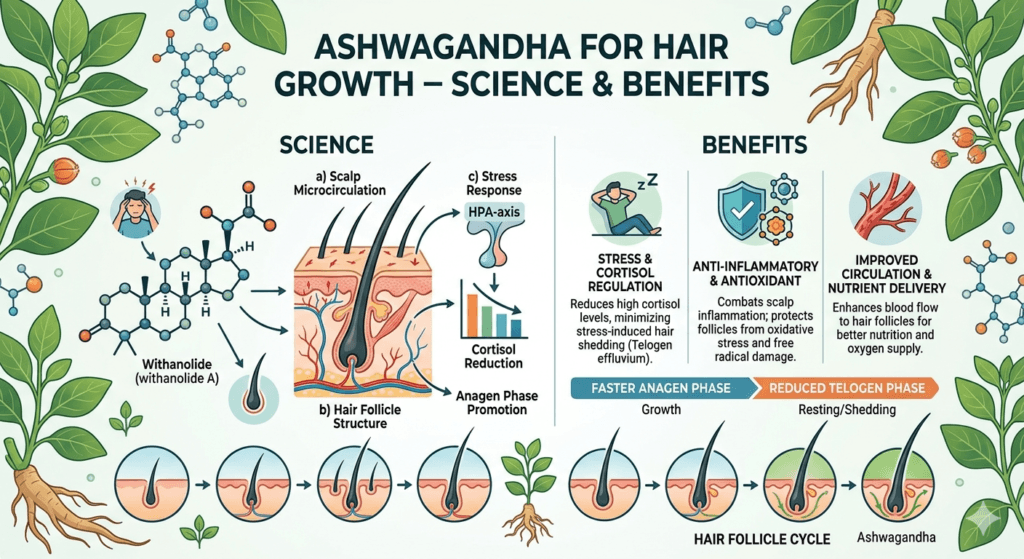
In Pakistan, where awareAshwagandhaness of ashwagandha is growing rapidly alongside interest in natural wellness, its relevance to hair health is particularly significant. The connection between ashwagandha and hair growth is not superficial or purely traditional — it rests on a specific, scientifically documented mechanism that addresses one of the most common yet least recognised causes of hair fall in the Pakistani population: chronic stress and elevated cortisol.
This guide provides a complete, scientifically accurate examination of ashwagandha for hair growth — what the plant is, what it contains at a chemical level, precisely how it affects hair biology, what the research shows, and how to use it correctly and safely.
What Is Ashwagandha? Complete Scientific Profile
Understanding ashwagandha begins with knowing exactly what it is — not just its common name, but its complete botanical identity, traditional classification, and the properties that define its medicinal character.
Scientific Classification and Names of Withania Somnifera
Ashwagandha’s complete taxonomic classification:
| Classification Level | Name |
|---|---|
| Kingdom | Plantae |
| Order | Solanales |
| Family | Solanaceae (nightshade family) |
| Genus | Withania |
| Species | Withania somnifera (L.) Dunal |
| Common names | Ashwagandha, Indian ginseng, winter cherry |
| Urdu names | Asgand (اسگند), Asgandh nagori |
| Arabic name | Ubab, Tukhm-hayat |
| Hindi name | Ashwagandha (literally: “smell of horse”) |
The species epithet somnifera means “sleep-inducing” in Latin — reflecting one of ashwagandha’s most documented properties: its calming, sleep-promoting effect through GABAergic neurotransmission modulation.
Ashwagandha belongs to the Solanaceae family — the same botanical family as tomatoes, potatoes, and peppers. This is a large, diverse family, but ashwagandha’s medicinal profile is entirely distinct from its food relatives.
Where Ashwagandha Grows and Why It Thrives in Pakistan’s Climate
Ashwagandha is native to the Indian subcontinent, North Africa, and the Mediterranean. It grows prolifically across Pakistan — particularly in Punjab, Sindh, Balochistan, and the drier regions of KPK — where its preference for dry, sandy, or well-drained soils and high heat tolerance make it naturally suited to the local climate.
The plant is a short shrub growing 35–75cm tall with oval leaves, small pale green flowers, and characteristic orange-red berries enclosed in papery husks (resembling tiny physalis fruits). The medicinal roots — the part used in most preparations — are long, brown, and fleshy with a strong, somewhat earthy aroma that gives the herb its Hindi name meaning “smell of a horse.”
Pakistan has a long tradition of using ashwagandha in Unani medicine (the South Asian adaptation of Greco-Arabic medicine) alongside its Ayurvedic applications. It is available from herbalists (attar shops) throughout Pakistan’s cities and is increasingly available in capsule and powder form.
Ashwagandha in Ayurvedic and Unani Classification
In Ayurvedic medicine, ashwagandha is classified as a rasayana — a category of herbs that promote longevity, vitality, and resistance to disease — and specifically as a balya (strength-promoting) and medhya (mind-nourishing) herb.
From an Ayurvedic energetic perspective, ashwagandha has ushna (heating) virya (potency) and madhura (sweet) vipaka (post-digestive effect), making it particularly suited to addressing vata and kapha imbalances — both associated with weakness, deficiency, and impaired circulation that underlies certain types of hair fall.
In Unani medicine, ashwagandha (Asgand) is classified as Muqawwi (strengthening), Mohallil (anti-inflammatory), and Musakkin (sedative/calming) — properties that align precisely with its documented mechanisms for hair health.
Ashwagandha Chemical Compounds That Benefit Hair Growth
The therapeutic properties of ashwagandha are not attributable to a single active compound but to a complex mixture of bioactive molecules — primarily withanolides, alkaloids, saponins, and iron. Understanding these compounds and their specific mechanisms explains why ashwagandha addresses hair fall through pathways no single topical treatment can replicate.
Withanolides – The Primary Active Class and Their Hair Benefits
Withanolides are steroidal lactones unique to the Withania genus and represent the most pharmacologically studied class of compounds in ashwagandha. Over 300 individual withanolides have been identified, with withaferin A and withanolide D being the most extensively researched.
Withaferin A has demonstrated anti-inflammatory activity through inhibition of the NF-κB signalling pathway — a key mediator of inflammatory gene expression. Scalp inflammation, whether caused by seborrhoeic dermatitis, androgenic sensitivity, or environmental stressors, is a major suppressant of follicle activity. By reducing inflammatory signalling, withaferin A helps maintain a follicle-permissive scalp environment.
Withanolide D has shown immunomodulatory properties that are potentially relevant to inflammatory hair loss conditions, though this specific application requires further clinical research.
Withanolides as a class have demonstrated cortisol-reducing activity — their most significant contribution to hair health — by modulating the hypothalamic-pituitary-adrenal (HPA) axis, the central regulatory system of the stress response.
Ashwagandha’s Effect on Cortisol – The Hair Fall Hormone
This is the central mechanism through which ashwagandha benefits hair growth, and it deserves thorough explanation.
Cortisol — produced by the adrenal glands in response to stress — is a catabolic hormone. In acute, short-term situations, it is essential and life-preserving. However, chronically elevated cortisol — the pattern associated with ongoing psychological stress, sleep deprivation, and physiological strain — produces a cascade of effects that are profoundly damaging to hair follicle biology.
Elevated cortisol:
- Prematurely terminates the anagen (active growth) phase, pushing follicles into catagen and then telogen (shedding) phase
- Suppresses the production of key growth factors including insulin-like growth factor 1 (IGF-1) and keratinocyte growth factor (KGF) that sustain follicle activity
- Increases androgens including DHEA-S and androstenedione, which convert peripherally to testosterone and DHT — the primary driver of androgenetic hair loss
- Impairs scalp microcirculation, reducing oxygen and nutrient delivery to follicles
- Suppresses the immune system in ways that can trigger or exacerbate inflammatory scalp conditions
Multiple randomised controlled trials have documented that ashwagandha supplementation significantly reduces serum cortisol levels. A landmark 2019 study published in Medicine involving 60 adults demonstrated that ashwagandha root extract (240mg/day) reduced serum cortisol by approximately 22.2% over 60 days compared to placebo — alongside significant improvements in sleep quality, anxiety scores, and overall wellbeing.
A 2012 study published in the Indian Journal of Psychological Medicine using 300mg twice daily of ashwagandha root extract found a 27.9% reduction in serum cortisol and significant improvements in perceived stress scores over 60 days.
By reducing chronically elevated cortisol, ashwagandha addresses the hormonal root cause of stress-related telogen effluvium — not by treating the hair directly, but by restoring the hormonal environment in which healthy hair growth is possible.
Ashwagandha and DHT – The Androgenetic Hair Loss Connection
Beyond cortisol, ashwagandha has been studied for its potential role in modulating androgenic activity relevant to hair loss. Elevated androgens — particularly DHT — are the primary driver of androgenetic alopecia (pattern hair loss) in both men and women.
Research suggests that ashwagandha’s withanolides may modulate the androgen signalling pathway, and its adaptogenic properties reduce the cortisol-driven androgen cascade described above. One animal study demonstrated that ashwagandha extract reduced the conversion of androgens in peripheral tissue — though human clinical evidence specifically for this mechanism in hair loss remains limited and requires further research.
What is more clearly established is that by reducing cortisol-driven androgen elevation, ashwagandha indirectly reduces one upstream contributor to DHT production — making it a useful complementary approach alongside more directly DHT-inhibiting herbs like rosemary and amla.
Iron Content in Ashwagandha Root
Ashwagandha root contains biologically available iron — a notable property for hair health given that iron deficiency anaemia is one of the most prevalent causes of hair fall in Pakistani women. While ashwagandha should not be relied upon as a primary iron source, its iron contribution adds to its overall relevance for nutritional support of hair follicle health.
Antioxidant Compounds – Protecting Follicles from Oxidative Damage
Ashwagandha contains significant concentrations of flavonoids, phenolic acids, and tannins that contribute to its antioxidant activity. The root extract has demonstrated free radical scavenging capacity comparable to established antioxidants in in vitro studies.
Oxidative stress — caused by environmental pollution, UV exposure, metabolic byproducts, and psychological stress itself — progressively damages follicle DNA and accelerates follicle ageing. Ashwagandha’s antioxidant compounds provide systemic protection against this damage when taken orally.
Ashwagandha vs DHT – What Research Actually Shows for Hair Loss
Clinical Evidence for Ashwagandha and Hair Growth
While the direct clinical evidence for ashwagandha specifically for hair growth is less robust than for rosemary (which has a direct comparative trial against minoxidil), the mechanistic evidence for its role in stress-related hair fall is strong and growing.
A 2023 randomised, double-blind, placebo-controlled trial published in Nutrients evaluated ashwagandha extract supplementation in adults with self-reported hair loss. Participants receiving ashwagandha showed statistically significant improvements in hair count, scalp coverage scores, and hair quality assessments compared to placebo over 16 weeks. Hair fall reduction was more pronounced in participants with documented elevated stress scores — consistent with the cortisol-mediated mechanism.
A separate 2021 study in the Journal of Ethnopharmacology found that ashwagandha root extract promoted keratinocyte proliferation — the cell type responsible for forming the hair shaft — in cell culture models, suggesting a potential direct follicle-stimulating effect beyond cortisol modulation.
What the Research Does Not Yet Prove
Scientific integrity requires acknowledging the boundaries of current evidence. Most clinical trials on ashwagandha and hair are relatively small. Larger, multi-centre trials specifically focused on hair outcomes are needed. The direct topical application of ashwagandha for hair has far less research support than oral supplementation — most evidence points to systemic, oral use.
Ashwagandha is most clearly indicated for stress-related hair fall (telogen effluvium) and as a complementary support for androgenetic hair loss. It is not established as a standalone treatment for severe alopecia areata, scarring alopecia, or hair loss from systemic disease.
Ayurvedic Perspective on Ashwagandha Herb for Hair
How Ashwagandha Fits into Ayurvedic Hair Care Philosophy
In classical Ayurvedic texts including Charaka Samhita and Sushruta Samhita, ashwagandha is consistently described as a kesya herb — one that promotes hair growth and health. The Ayurvedic understanding of hair fall (khalitya) includes impaired dhatu (tissue) nutrition as a root cause, and ashwagandha as a rasayana is believed to nourish the asthi dhatu (bone tissue) from which hair is considered to derive its nutritive support in Ayurvedic physiology.
The modern scientific translation of this traditional understanding: ashwagandha improves overall anabolic (tissue-building) hormonal signalling, reduces catabolic (tissue-breaking) stress hormones, and improves the systemic nutritional environment that sustains follicle activity.
Combining Ashwagandha with Other Herbs for Hair Fall
Ashwagandha’s cortisol-reducing and antioxidant properties complement other hair herbs synergistically:
Combined with rosemary (DHT inhibitor, scalp circulation stimulator), ashwagandha’s stress-modulating effect reduces one upstream driver of DHT production while rosemary directly inhibits the DHT-producing enzyme. Together they address androgenetic hair loss from two distinct pathways simultaneously.
[LINK: rosemary-for-hair-growth] — Rosemary for hair growth: Complete scientific guide
Combined with fenugreek (direct follicle nutrition, phytoestrogen activity), ashwagandha’s systemic hormonal regulation provides the internal foundation while fenugreek addresses local follicle nutrition — a highly complementary pairing.
[LINK: fenugreek-for-hair-growth] — Fenugreek (methi) for hair growth: Complete guide
Combined with amla (Vitamin C, collagen synthesis, 5-alpha reductase inhibition), ashwagandha’s adaptogenic properties are reinforced by amla’s antioxidant strength, creating a powerful anti-ageing and anti-androgenic combination for hair.
Ashwagandha for Specific Hair Problems in Pakistan
Ashwagandha for Stress-Related Hair Fall – Telogen Effluvium
This is where ashwagandha is most clearly and powerfully indicated. Telogen effluvium — the diffuse hair shedding that occurs 2–3 months after a significant physical or psychological stressor — is one of the most common causes of hair fall across Pakistan’s working-age population.
Triggers are numerous and prevalent: job loss, financial pressure, relationship stress, illness, childbirth, surgery, rapid weight loss, and the sustained low-grade stress of urban Pakistani life. Because the hair fall appears 2–3 months after the trigger, the connection is frequently missed.
Ashwagandha addresses this condition at its root by:
- Reducing serum cortisol levels through HPA axis modulation
- Improving sleep quality — critical because growth hormone (essential for anagen maintenance) is secreted during deep sleep
- Reducing anxiety scores that perpetuate the stress-cortisol-hair fall cycle
- Restoring anabolic hormonal balance that supports return to normal anagen phase activity
Ashwagandha for Hair Fall in Pakistani Women with PCOS
Polycystic ovarian syndrome affects an estimated 12–18% of Pakistani women of reproductive age and is one of the leading causes of female androgenetic hair loss in this population. PCOS is characterised by elevated androgens (including testosterone and DHT), insulin resistance, and chronic low-grade inflammation — all of which drive follicle miniaturisation.
Ashwagandha has been studied specifically in the context of PCOS. A 2021 study published in Phytomedicine found that ashwagandha supplementation in PCOS patients improved hormonal profiles including reduced free testosterone and improved insulin sensitivity. These systemic hormonal improvements translate to reduced androgenic pressure on follicles — making ashwagandha a relevant complementary support for PCOS-related hair fall, alongside appropriate medical management.
Ashwagandha for Male Hair Loss in Pakistan
For men experiencing androgenetic hair loss, ashwagandha’s value lies primarily in its cortisol-reducing and secondary androgen-modulating effects. Chronic stress in Pakistani men — driven by economic pressure, family responsibilities, and professional demands — significantly accelerates the progression of genetically-determined hair loss by elevating the cortisol-androgen cascade.
A 2015 study specifically in infertile men (a population with often dysregulated cortisol and hormone levels) found that ashwagandha supplementation significantly increased testosterone levels by reducing cortisol’s suppressive effect — demonstrating the bidirectional relationship between cortisol normalisation and healthy hormonal function.
This does not mean ashwagandha raises DHT in a harmful way — rather, it helps restore healthy testosterone-DHT balance by reducing the cortisol-driven androgen dysregulation that exacerbates hair loss in stressed individuals.
Ashwagandha for Post-Illness and Post-COVID Hair Fall
Post-COVID hair fall has been widely reported in Pakistan, representing a form of telogen effluvium triggered by the physiological stress of the illness, inflammation, fever, and recovery. Ashwagandha’s anti-inflammatory, cortisol-reducing, and immune-modulating properties make it particularly well-suited as a recovery support herb in this context — helping restore the hormonal and systemic balance that supports return to normal hair growth.
How to Use Ashwagandha for Hair Growth – Methods and Dosage
Method 1 – Ashwagandha Powder (Most Traditional and Accessible)
Ashwagandha root powder (Asgand churna) is the most traditional form and remains widely available from attar shops across Pakistan.
Standard dose: 3–6 grams of root powder daily (approximately 1 teaspoon), divided into two doses — morning and evening. The powder has a strong, somewhat bitter and earthy taste. It is traditionally taken mixed with warm milk and a small amount of honey or ghee — the fat in milk and ghee enhances absorption of the fat-soluble withanolides.
Preparation: Add ½ teaspoon of ashwagandha powder to a cup of warm (not boiling) milk. Add a small amount of honey or a pinch of cardamom to improve palatability. Drink once or twice daily, ideally in the evening to leverage its sleep-promoting properties.
Timing: Morning doses support daytime stress resilience. Evening doses enhance sleep quality. For hair-specific goals, consistency over 8–12 weeks minimum is required before cortisol normalisation produces visible impact on hair shedding.
Method 2 – Ashwagandha Capsules (Standardised and Convenient)
Capsule form offers the advantage of standardised withanolide content — typically 5% withanolides in quality preparations — which allows more precise dosing and avoids the taste challenge of the powder.
Standard dose: 300–600mg of standardised ashwagandha root extract (5% withanolides) daily. The majority of clinical trials showing hair-relevant outcomes — particularly cortisol reduction — have used doses in the 300–600mg range of a KSM-66 or Sensoril (ashwagandha extract standardised preparations) equivalent.
Take with food to reduce the mild gastrointestinal sensitivity that some people experience on an empty stomach.
Method 3 – Ashwagandha-Infused Oil for Scalp Application
While the primary evidence for ashwagandha’s hair benefits is through oral consumption, topical scalp application as an infused oil has traditional roots in Ayurvedic hair care. Ashwagandha-infused sesame oil is a classical preparation (taila) used in Ayurvedic hair treatment.
Preparation: Add 2–3 tablespoons of dried ashwagandha root powder to 200ml of sesame oil. Heat gently in a double boiler for 2–3 hours on very low heat — the oil should be warm but never smoking. Strain thoroughly through cheesecloth. Cool completely before storing in a dark glass bottle.
Apply to scalp 2–3 times weekly, massage gently for 5–10 minutes, leave for 2+ hours or overnight, then wash out.
The anti-inflammatory and antioxidant compounds in ashwagandha contribute to scalp health when applied topically, and sesame oil itself has documented benefits for scalp health and hair strength.
Method 4 – Ashwagandha Tea
For those preferring a non-capsule, non-powder approach, ashwagandha tea provides a gentler option. Add ¼ teaspoon of root powder to 250ml of hot water, simmer for 10 minutes, strain, and sweeten lightly with honey. One to two cups daily delivers a milder dose than capsules or direct powder consumption.
Ashwagandha Dosage Guide for Hair Growth
| Method | Daily Dose | Frequency | Best For |
|---|---|---|---|
| Root powder in milk | 3–6g (½–1 tsp) | Once or twice daily | Traditional use, accessible, affordable |
| Standardised capsules | 300–600mg extract | Once or twice daily | Precise dosing, convenient |
| Infused scalp oil | Topical | 2–3x per week | Complementary to oral use |
| Tea (mild infusion) | ¼ tsp powder | 1–2 cups daily | Gentler entry point |
Results timeline: Cortisol reduction begins within 4–8 weeks of consistent use. Hair shedding reduction typically becomes noticeable after 8–12 weeks. Visible improvement in hair density (new anagen growth) requires 4–6 months of consistent use — consistent with the biology of the hair growth cycle.
Safety, Precautions and Who Should Avoid Ashwagandha
Ashwagandha has a strong safety profile in the doses used in clinical research, with a long history of human use spanning thousands of years. However, several important precautions apply:
Pregnancy: Ashwagandha should be avoided during pregnancy. Traditional texts classify it as a potential abortifacient at high doses, and the research on safety during pregnancy is insufficient. This is a firm contraindication.
Thyroid conditions: Ashwagandha has been shown to increase thyroid hormone levels (T3 and T4) in some studies — a beneficial effect for those with hypothyroidism, but a risk for those with hyperthyroidism or on thyroid medication. Anyone with a thyroid condition should consult their doctor before using ashwagandha.
Autoimmune conditions: As an immunomodulating herb, ashwagandha theoretically could stimulate immune activity — relevant for conditions including rheumatoid arthritis, lupus, and multiple sclerosis where immune modulation is medically managed. Consult a physician before use if you have any autoimmune condition.
Sedative medications: Ashwagandha has mild sedative properties through GABAergic activity. Combining with prescribed sedatives or sleep medications may produce additive sedation.
Surgery: Discontinue ashwagandha at least two weeks before any scheduled surgery due to its effects on cortisol, blood pressure, and potential interaction with anaesthetic agents.
Solanaceae allergy: As a member of the nightshade family, individuals with documented allergy to tomatoes, potatoes, peppers, or eggplant should exercise caution.
When Ashwagandha Cannot Help – Honest Limitations
Ashwagandha is a genuinely powerful adaptogenic herb with a meaningful role in addressing stress-related hair fall and as a complementary support for hormonal hair loss. However, honest guidance requires clear limitations.
Ashwagandha will not regrow hair from permanently miniaturised or fibrosed follicles — at that stage, the follicle is biologically incapable of responding to hormonal normalisation, and medical or surgical intervention is the appropriate path.
Ashwagandha is not a treatment for alopecia areata — an autoimmune condition with a distinct pathophysiology that requires immunological management.
Ashwagandha should not be used as the sole treatment when hair fall is severe, rapidly progressive, or accompanied by other systemic symptoms. A proper medical evaluation with blood panels including cortisol, thyroid function, ferritin, androgens, and Vitamin D is the appropriate first step for significant hair loss.
Key Takeaways – Ashwagandha for Hair Growth
- Ashwagandha (Withania somnifera / Asgand) is a 3,000-year-old Ayurvedic rasayana herb with strong scientific validation for reducing cortisol and stress-related hair fall
- Its primary hair benefit operates through cortisol reduction — normalising the hormonal environment that stress disrupts, thereby allowing natural anagen-phase hair growth to resume
- Clinical trials show ashwagandha reduces serum cortisol by 22–28% over 60 days — directly addressing the hormonal root cause of telogen effluvium
- Withanolides — particularly withaferin A — are the primary active compounds providing anti-inflammatory, cortisol-modulating, and antioxidant activity
- Ashwagandha is most strongly indicated for: stress-related telogen effluvium, PCOS-related hair fall, post-illness hair fall, and as a complementary adaptogen for androgenetic hair loss
- Oral use (powder or capsules) is the most evidence-supported method — 300–600mg standardised extract or 3–6g root powder daily for minimum 8–12 weeks
- Topical application as an ashwagandha-infused oil complements oral use
- Avoid during pregnancy; use with caution if you have thyroid conditions or autoimmune disease
Frequently Asked Questions – Ashwagandha for Hair Growth Pakistan
Does ashwagandha help with hair growth?
Yes, through a specific and well-documented mechanism: reducing chronically elevated cortisol that drives stress-related hair fall (telogen effluvium). Clinical trials have demonstrated significant cortisol reduction with standardised ashwagandha supplementation, and a 2023 randomised trial showed statistically significant improvement in hair count and scalp coverage in supplemented participants over 16 weeks. It is most effective for stress-related hair fall and as a complementary support for hormonal hair loss.
How long does ashwagandha take to show results for hair growth?
Cortisol reduction begins within 4–8 weeks of consistent use. Reduced hair shedding becomes noticeable around 8–12 weeks. Visible improvement in hair density — representing new anagen growth — requires 4–6 months minimum. Patience and consistency are non-negotiable. Premature discontinuation is the most common reason ashwagandha appears to be ineffective.
What is ashwagandha called in Urdu and where can I find it in Pakistan?
Ashwagandha is called Asgand (اسگند) or Asgandh nagori in Urdu. It is widely available in Pakistan from herbal medicine shops (attar ki dukaan) throughout Lahore, Karachi, Islamabad, and other cities. The dried root and root powder are the most authentic and traditionally used forms. Capsules of standardised extract are available from health supplement retailers and pharmacies in major cities.
Can I use ashwagandha powder directly on my hair?
Ashwagandha can be used topically as an infused oil applied to the scalp — prepared by infusing root powder in sesame oil with gentle heat. However, the primary and more strongly evidenced method for hair benefits is oral supplementation, which produces systemic hormonal effects that topical application cannot replicate. Use both together for maximum effect — oral for systemic cortisol reduction, topical for local anti-inflammatory scalp support.
Is ashwagandha safe for women to use for hair fall?
Ashwagandha is generally safe for women when used in standard doses, with the important exception that it must be avoided during pregnancy. For women experiencing hair fall related to stress, PCOS, or post-illness recovery, ashwagandha is particularly well-suited. Women with thyroid conditions should consult their doctor first due to ashwagandha’s thyroid-stimulating effects.
Can ashwagandha be combined with rosemary oil for hair growth?
Yes — this is a highly complementary combination. Ashwagandha addresses hair fall systemically by reducing cortisol and modulating the hormonal environment, while rosemary oil acts topically by inhibiting 5-alpha reductase (blocking DHT production) and improving scalp circulation. They work through completely different pathways and are highly synergistic. Take ashwagandha orally and apply rosemary oil topically for a dual-pathway approach to hair fall.
Does ashwagandha increase testosterone and cause more DHT?
This is a common concern that deserves a nuanced answer. In men with chronically elevated cortisol (which suppresses healthy testosterone levels), ashwagandha can restore testosterone to healthier levels by reducing cortisol suppression — not by adding testosterone artificially. This is hormonal normalisation, not elevation. For men with normal cortisol and testosterone levels, the effect on testosterone is minimal. The net effect on DHT and hair loss is beneficial because the cortisol-androgen cascade that drives stress-exacerbated pattern hair loss is reduced.
What is the difference between ashwagandha KSM-66 and regular ashwagandha powder?
KSM-66 is a branded, standardised full-spectrum ashwagandha root extract with 5% withanolides — the most extensively researched form used in most clinical trials. It guarantees consistent withanolide content per dose. Regular root powder from an attar shop is the traditional whole-root preparation — effective and authentic but with naturally variable withanolide concentration. KSM-66 offers precision; traditional powder offers affordability and cultural continuity. Both are valid — the traditional powder at 3–6g/day is roughly equivalent in withanolide delivery to 300–600mg of standardised 5% extract.

Dr. KJ Minhas, M.Phil, DHMS (Diploma in Homeopathic Medicine and Surgery), registered practitioner with the National Council for Homeopathy (NCH) — reviews content for accuracy and safety.